Tuesday, June 19, 2012

Tagesausflug: A Monastery, Castles, and Wine


At the end of May, to celebrate the end of our program courses (we still had another month of university courses), we took a day trip out of the city.  Our trip started out with a stop at Kahlenberg a hill near Vienna. From the top, there’s a great view of the city and it was neat to orient where we lived and places we had visited from above.


We then headed to Kloster Neuburg, a partially completed castle, monastery, and church about a half hour outside of Vienna. A large castle complex was planned by Emperor Karl VI, but his daughter Maria Theresia stopped construction after her father’s death as she wasn’t particularly fond of Kloster Neuburg. Today, a quarter of the planned castle exists.


We also visited the Baroque style church that’s located there:


and saw some of the religious items the monastery owns:


Admittedly, Kloster Neuberg was a bit underwhelming for me after seeing quite the collection of castles and Baroque churches over the semester.

Our next stop was Kruezenstein, a castle that was haphazardly built from parts of other castles to form a new caste. The result is quite picturesque and the castle is used as a movie set for period pieces quite frequently.


The text under the clock translates to: “Who rests rusts.”


We finished up the day by visiting a family-run vineyard in Trauenfeld. The owner of the vineyard showed us the vineyard and explained how wine grapes are grown and we then headed down to his wine cellar to try a number of different varieties of wine.  He also shared a number of wonderful life lessons to be gained from wine throughout the evening. Some of my favorites: International cooperation is possible (since all wine grape plants today are originally European plants grafted to originally American roots). Everyone has their own preferences and thus everyone has their own preferred flavor of wine and should celebrate when they find it (made even better by our professor immediately responding “But you can’t celebrate if there’s no wine in your glass” and holding up her empty glass for a refill). Regardless of where you come from or where you’re going in the future, when you are drinking the same wine together, you are a community in that moment.  We finished up the day by eating a delicious dinner at the restaurant associated with the family winery, complete with even more wine and champagne. Definitely one of the most enjoyable evenings I’ve had during study abroad.


Wednesday, May 30, 2012

Vienna: Museums, Parks, and Theater Continued


After spring break, I settled back into my life in Vienna, including immediately needing to get over another cold. I’ve honestly been sick more times this semester than in the past several years combined. It’s a bit frustrating at times, but I’ve managed to push through each of my bouts of illness. Also frustrating was having my wallet stolen at the beginning of May, but thankfully, with time, money, and some work, everything was replaceable.

One of the best things about Vienna has been seeing the flowers bloom as spring arrives. Especially wonderful were the blooming lilacs. Lilacs are my favorite scent and immediately remind me of home and family, since I have a lilac bush back home.  Smelling the lilacs was like a scent of home in Austria,  simultaneously wonderful and a bit sad since it made me a little homesick.


Another flower highlight is the rose garden in the Volkspark. There is every imaginable variety of rose in the garden, and our professor was completely on the mark when she described the roses as spectacular.


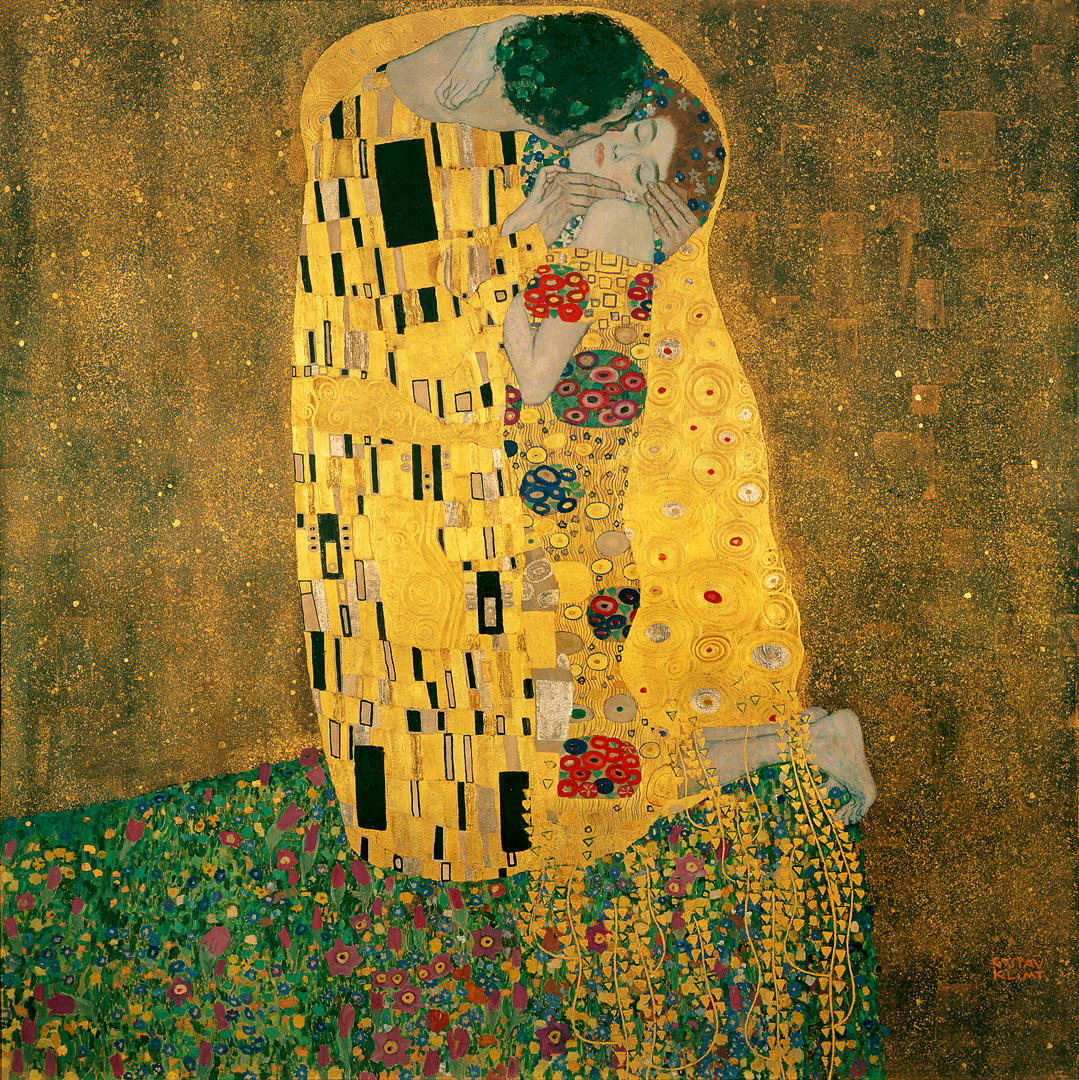
For class, we’ve continued to visit more museums. Highlights include Belvedere, the summer palace of Prince Eugene of Savoy, who served as a very successful military general for the Hapsburgs.  It’s currently an art museum with art from a variety of art periods, including Gustav Klimt’s Der Kuss.


Source: http://de.wikipedia.org/w/index.php?title=Datei:Gustav_Klimt_016.jpg&filetimestamp=20120409065933

Here are some shots of the palace itself.


Near Belevedere is Schwarzenburgplatz, which has this cool sculpture. According to our professor, it is composed of people interconnected with each other, although I just see cool geometric shapes. Regardless, I like it. In an interesting juxtaposition, behind the sculpture are a fountain (It’s great to walk through the square when it’s warm because of the mist) and the Soviet War Memorial.


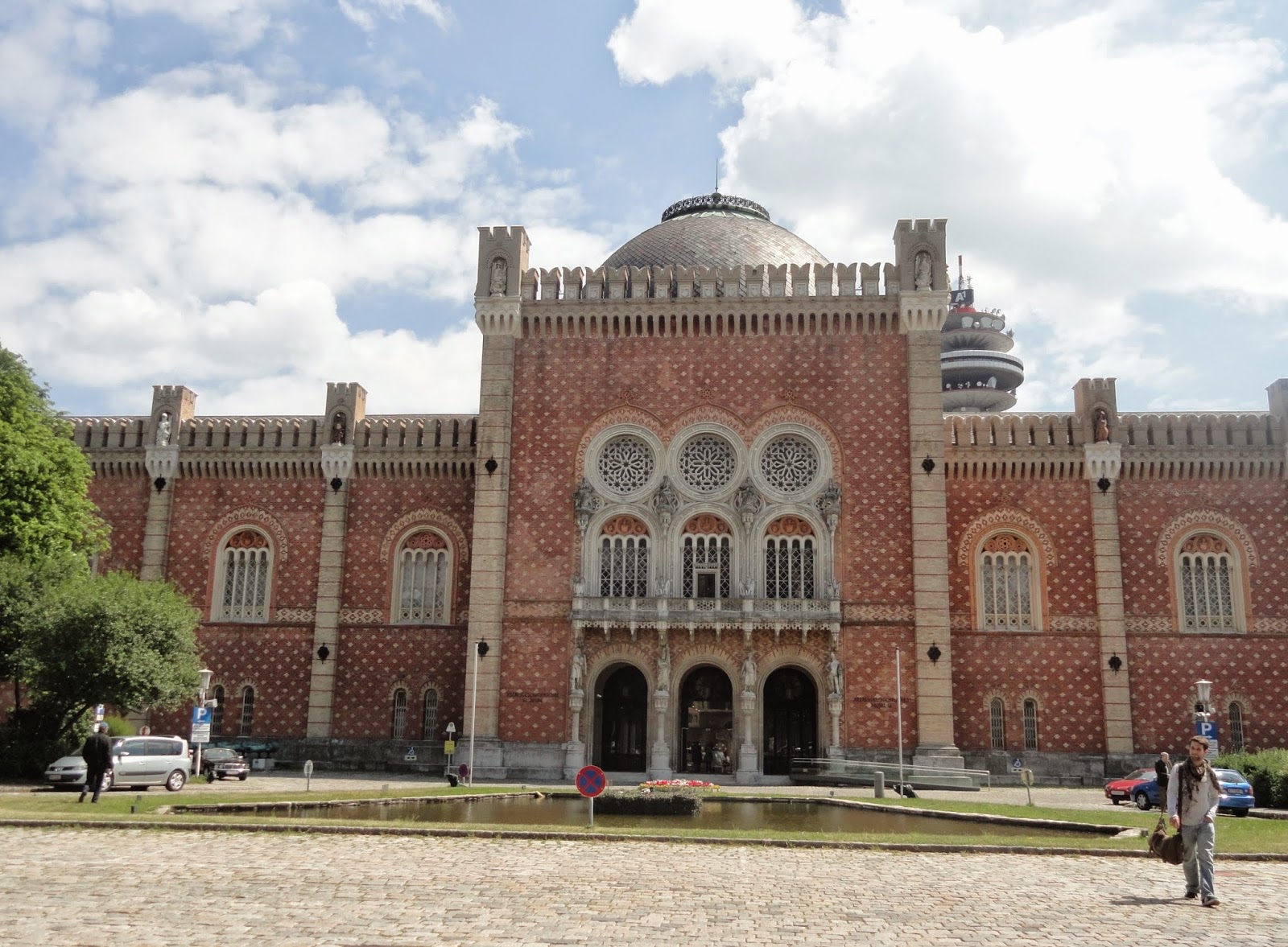
We also visited the Heeresgeschichtliches Museum, Vienna's military history museum. Although not the most interesting thing for me, seeing the car/clothes in which Franz Ferdinand was killed (subsequently leading to the start of World War I) and the flamboyant Hungarian military uniforms, including turquoise ostrich feathers an leopard skin capes, were cool to see. 


I also finally visited Stephansdom and I was surprised to find that it was one of the most beautiful things I've seen in Vienna. The day I was there, long colored plastic sheets were covering the windows (really similar to lighting gels), creating some absolutely beautiful light patters on the wall. Forget the Gothic style church architecture and the Baroque altars, the play of color and light on the wall was the amazing part. In places, the way the blues played on the ceiling made it look like the sky, as if it were enchanted like the Great Hall at Hogwarts.


Speaking of lighting, I’ve continued to be unimpressed by the lighting and yet impressed by the other elements of the theater we’ve seen. The worst experience was definitely a long production of Faust in which I spent much of the performance wondering whether I would faint from dehydration, while a highlight was Verrücktes Blut, a play based on a French film about a teacher taking her diverse group of underachieving students hostage. The play was good, but more impressive was seeing the French film La journee de la jupe (Skirt Day). I’ll just say it’s been a long time since a movie has made me cry. I highly recommend it.

However, the best play I've seen was Cate Blanchett and her theatre company's production of Big and Small. Although the scenes didn’t exactly connect together well, each scene was fantastic individually and the play was both funny and full of important themes. Most of all, Cate Blanchett is an amazing actress. I knew she was a great from her films, but seeing her perform on stage was a pleasure.

I also took a tour with my class of the Burgtheater, Vienna’s largest theatre where we’ve seen a number of shows. It was great to see the behind the scenes aspects of the theatre and the Burgtheater is impressive. There is a huge revolving stage, a 17m tall understage storage area, and 120 fly lines. However, the most fascinating part of the Burgtheater and theater here in general is how the entire scenery is changed on a daily basis. I can’t imagine working in a theater where the entire set needs to be rebuilt every day.


The following are Gustav Klimt's beautiful paintings in the side entrances:


Although illness and school have presented challenges, I'm really enjoying Vienna and am looking forward to spending another month here.


Monday, May 28, 2012

Auschwitz-Birkenau


While in Poland, we went to Auschwitz-Birkenau. Honestly, no set of words I’m going to come up with is going to be able to adequately express the experience, but despite that, I’ll attempt to pull together my thoughts, especially now that I’ve had some time to process.  I also purposefully didn’t take any photos that day, in part because of what I perceive as the problematic nature of having concentration camps be tourist sites (although as our guide explained, sites like Auschwitz also need to be open to the public in order to remember what happened and prevent it from happening again), but mostly, because it just seemed inappropriate to me at the time.  And, even if I had taken a photo, I still don’t think it would adequately convey the experience.

More than anything else, the whole experience was overwhelming emotionally. The sheer number of people who were murdered was overwhelming. It was overwhelming that they were murdered solely because of their religion or ethnic group or political beliefs. The systematic way in which the murders were carried out was overwhelming. The way that the prisoners of the camp were treated was overwhelming. The way female prisoners were treated was especially overwhelming to me as a woman.

But although all of these numbers and statistics and facts were horrific and terrifying, the most emotionally overwhelming part of the experience wasn’t these facts. It was the personal items of the victims; because these items showed in a way that numbers cannot that each victim was a unique individual whose talents and gifts were lost to the world forever. Shoes, brushes, glasses, toys, clothing, suitcases. Especially the suitcases: each stamped with a name, a profession, an address. The number 1.3 million is painful. Actually realizing that that number means 1.3 million people was so much worse. There truly aren’t words.

Even weeks later, I’m not entirely sure what to do with the experience. I’m not sure I’ve even allowed myself to feel all of the emotions of the experience yet. At this point, all I can really say it’s an experience I will never forget.

Sunday, May 27, 2012

Krakow: A Welcome Surprise


During the last few days of my spring break, I traveled with the rest of my study abroad program to Krakow, Poland. I didn’t have very many expectations for the trip, and was surprised by how much I liked Krakow. It had the beauty of an old European capital without being filled with tourists like Prague or too focused on being pretty, which is a feeling I sometimes get from Vienna. It was simply pretty without needing to make a huge effort or fuss about it.

One of the prettiest parts of Krakow is the strip of park that surrounds the central inner city. It was really enjoyable to walk through and added appreciated open space to the city.


Our first day, we had a day long guided tour through the city that covered the main sites and museums of the city, which was a particularly packed day. We started out at the Wawel castle. Although Poland has been ruled by other empires for much of its history and its capital today is Warsaw, Krakow was the capital of Poland from 1038 to 1569. The castle was filled with a huge collection of gorgeous tapestries. Next to the castle, is Wawel Cathedral, which includes a large canopy with a coffin underneath of Poland’s patron saint Stanislaus.


We then visited the Collegium Maius Museum, the University of Krakow’s oldest building, which outlines the history of the university and displays a variety of artifacts from the university’s collection. One of the University’s most famous students is Nicolas Copernicus.


We took a lunch break at the Main Market Square. On the square is a large sculpture entitled Eros Bendato by Igor Mitoraj, the same sculptor who made the sculpture in The Hague. You can actually climb in the head as well.


After lunch, we went to St. Mary’s Basilica which makes quite a presence on the central square, in part because a trumpeter plays a signal every hour from the church’s tower. 


We were not allowed to take photos inside the church (or the castle-hence the above lack of internal photos), but the interior of the church is one of the most beautiful things I have ever seen. The Gothic style altar was impressive, but the most beautiful part of the church was the awe-inspiring colorfully decorated ceiling. Here’s a photo from the Internet, although I don’t think it does the church justice.


Source: http://en.wikipedia.org/wiki/File:Cross_inside_St_Mary%27s_church_Krakow.JPG

We finished up the tour by visiting Kazimierz, Krakow’s Jewish quarter. It’s well known as being the filming site for many Holocaust films, including Schindler’s List, although the Krakow ghetto was located elsewhere. Although there are several synagogues in the district, there are very few Jewish people living in Krakow today. To give a sense of the dramatic change, Jews made up 25% of the city’s population, about 60,000 people in 1938, but Krakow’s Jewish population numbers only 600 people today. In an uncomfortable and yet revealing incident, we were yelled at by a Polish man in front of the Holocaust memorial. Although I couldn’t understand what he was saying, from what I gathered, the source of his hostility was the fact that our tour was taking place in German. It certainly brought to the forefront the deep emotions that remain in Europe today regarding the events of World War II. We also ate at a Jewish restaurant in the district as a group. Although I’m not sure how truly authentic the food was, it was certainly delicious and the accompanying Kazimierz music was enjoyable.


After our tour, we were free to explore the city. We wandered some along the Vistula River and explored Krakow, which in addition to being historically beautiful, is also a quirky, hip city with lots of young people.


The dragon statue refers to the story of the Wawel Dragon. According to legend, a dragon lived on the foot of the hill where the castle is located along the river. A variety of stories are told about the dragon, who has since become one of the main city symbols of Krakow.


Another great aspect of visiting Krakow: the prices. In comparison to the countries I’ve visited in Western Europe, most things in Krakow seemed remarkably affordable. Thanks to the great exchange rate, we spent much of our free day shopping at “pay by the kilo” second hand clothing stores. Additionally, the number of affordable restaurants with delicious, healthy food was impressive. Highlights included pirogues and a vegetarian restaurant right by our hotel. Overall, my time in Krakow was wonderfully enjoyable and although it’s certainly premature, I’m already hoping to return to travel more in Poland.